Four Days Without the Sky

Advertisements

Update for Week of July 24

Homemade Deliciousness

My joie de vivre has returned. Friends on the phone note that I sound much better. And indeed, I do feel better. I am eager to walk about under my own power and have been leaving the house more often. Some pains do show up sporadically in the hand and foot. But getting out of the wheelchair is a welcome phase of recovery.   Now that I am in the hands of a fantastic therapist, I have begun contemplating the contrast with bumpy portions of recovery. This journey makes me wonder about the humanity in our medical system.

Grady Memorial is Atlanta’s only trauma hospital. As a patient in the hospital, I was recovering from the most extensive physical trauma I knew. All I wanted to see in that space was a vision for my healing. It takes peace of mind, a sense of safety, support, and hope. People say that the surgery and trauma crew are excellent at Grady. Immediately after that, in the PACU (post-anesthesia care unit), I realized my need for help to heal post-trauma.

Cooking Up Joy in the Kitchen

I was taken to the PACU after my operation early AM on May 16th. This is where I had to wait about 12 hours after surgery to receive a hospital room. The PACU is a large shared hall; I was in Bay 8. My pre-operation nurses were super sweet. The contrast here was salty. The nurse, ironically named Moses, could hear me asking for water but casually attended to his computer in my bay. The PACU nurse could not be bothered to provide me with either water or food, though it was suggested I should get nutrients. For 15 minutes at least, he ignored my repeated requests for water. He did this after telling me to wait for the next round of meals after I had slept through the lunch service in a post-anesthesia haze. It was the first time I felt like crying. Later, he rested his elbow on my bed while talking about his rental property in Nigeria on his cell phone.

After insisting on a change of nurse and bay, a kindhearted nurse brought me a fruit cup and juice to quench my soul. As I waited for the room assignment in the Bay of Ugliness, I was not allowed additional visitors. In the shared bay, I was told visitations are restricted. While waiting in this shared space, I could hear the screams of patients ringing out across the hall. Each bay shouted shocks in the early moments of consciousness after surgery. These sounds and agony took a toll on my spirit. The wait for a longer-term observation room was the first taste of absolute helplessness.

Brasstown Bald, Highest Spot in Georgia

When I was wheeled into my assigned room, it was nearly midnight. And I had a roommate. My roomie already had the window side and she was trying to sleep when I arrived. I was placed on the other side of the curtains she would keep drawn. The four days I spent there were a lesson in patience. A series of technicians entered the room for various tasks. Throughout the day (and night), people check on you to measure your blood pressure, deliver a regiment of pills, and rarely for cleaning. Sometimes, I felt that I was a task, not a human. There were constant beeping noises from machines attached to me. Without windows and sunlight, the healing effect of trees, I felt I was in a science experiment. My roommate kept the TV on and loud at night for background noise (ugh). Between her calls for help, and our regular tech- checks, it was hard to sleep well through the night. The resident doctor in training would arrive, grumpy at 6 am, then wake me up to ask how I slept.

The hand specialist working with me at Emory’s 21 Ortho Lane is a dream. Marcia is my ideal healthcare caregiver. She is everything I could hope for in a therapist. Marcia is competent, kind, and thoughtful. She communicates well, and her presence puts me at ease. Wow. She is a gift and a gem in this process. I am so glad about this because arriving at a therapist has not been easy. There have been pushbacks from the insurance company and the foot clinic suggesting that I could not work on hand and foot during the same period (like the first limb had to be discharged before the other limb is eligible for therapy!) A bureaucracy like this makes me wonder about the efficacy of our healthcare system.

First Day at Hand Help

Another sore spot within health care has been the exchange of knowledge. Overall, I felt I was under-informed about the procedures in surgery and learning about the extent of my injuries. I am interested in asking specific questions about my body. As a lawyer growing up in a medical household, I realize that the question of informed consent is entirely another issue (you must know a meaningful amount about the choices in front of you). Still, many of my providers could not provide the bare minimum a decenct explanation. When I asked for clarifications and answers, I was told that a surgeon had talked to me post-surgery. I retorted: You mean when I was high and hallucinating in Lalaland? Days later, I chased down some surgeon to get a basic explanation of my injuries. Til then, support staff directed me to check MyChart (while I was still in the hospital). Without an insider’s heads-up for proper hospital checkout, I wonder where I would have been. The doctors in my family helped me retrieve the script for therapy and medicines before I left. The hospital sent me home with some medications, but I am glad I doubled checked ( I would have been without Oxy if I had not paid attention). While I was present and before being discharged, I waited 2+ hours for MyChart login credentials.

Reflecting on my journey here, I realize my physical pain was not the worst part of my accident. My biggest bumps were mean people and the psychological sense of dependence. Walking on my own makes a huge contrast. Now, I am safely away from Grady Hospital and gratefully in front of the windows with Marcia. Before we begin treatment, she wraps my wrist with towels and a heating pad. I gaze into the green grass and return to a sense of calm. She asks about my weekend, and I tell her about the past four days excursion to the Georgia/ North Carolina borderland. I spent time in a passive solar modern eco cabin with windows with views and thoughtful amenities galore. There, I shared meals, splashes, and care with cherished loved ones. It is the version of health care that has been most healing.

Truthing at Top of Brasstown Bald

I walk! and Wonder

Advertisements

Update for Week of July 17

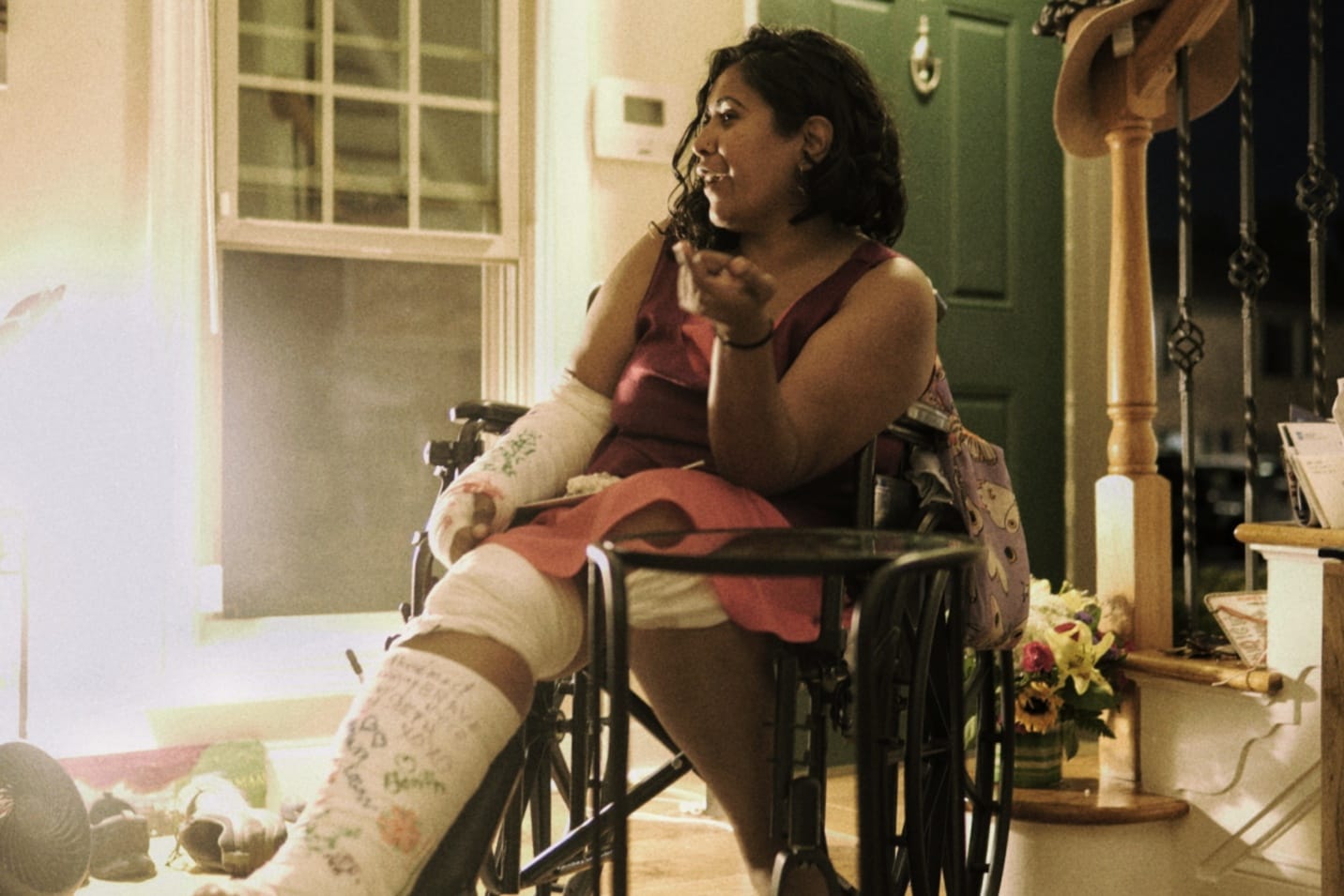
Yesterday, I walked around Patel Plaza in Decatur. From afar, I looked like any able-bodied person. To my overwhelming surprise, at my Monday, July 17th appointment, I was freed from my foot cast and given permission to walk! I expected my ankle would need a scooter or other walking contraption. But, according to my surgeon, I can be fully weight-bearing on my right leg. Right now, only loose-fitting shoes hold my swollen foot and ankle. Meanwhile, my wheelchair sits at home. Without it, I can blend into the background in a crowd.

Up close, you can see the wound on my right leg where my ankle was sewn together. The scar has the intriguing shape of a closed eye with stitches as eyelashes. Walking up the toiletry aisle at Patel Brothers, I considered buying henna to make fun temporary tattoos on my wound scars. I could draw an amusing face, a butterfly, or a flower wreath once some swelling is reduced.   Since I am not taking pain medications or dangerous drugs, I can also drive. The sudden jolt in autonomy has me both appreciating independence and adjusting to some internal changes.

I no longer need a chaperone to leave the house! Though I am no fan of driving, I appreciate flexing my American (car-based) independence. After being driven around and needing accessibility infrastructure, I have a new perspective on the importance of access, curb cuts, and well-placed entryways. If you have ever walked across a smoking Hot-lanta asphalt in the middle of the day, you will appreciate the relief of awnings and shade. For all my car-based excursions, my temporary handicapped parking permit has been a blessing. As my body adjusts to the summer weather, I have been walking through errands in a heat daze with a little limp.

Though I have started driving again, I remember why I hate it. Driving is dangerous for motorists, pedestrians, and cyclists. When in their cars, most people fall into little bubbles within their minds. Car-based design is wasteful and isolating. Atlanta is incredibly spread out. I wonder what I would have done if I did not have a volunteer crew of drivers. Driving here requires a different attitude. This city is full of out-of-towners and non-drivers who moved here and had to get hip to driving. Of my many volunteer chauffeurs, there is only one I would like to drive me again. Many SUV drivers appear indifferent to stop signs and pedestrians. To make going places here more challenging, Atlanta also suffers from municipal ineptitude. The city pothole crew plays a never-ending Whack-a-Mole game with our street. As a result, driving in Atlanta is often about being appropriately attentive. Near my home, the 285 loop and access to Interstate 85 N requires a series of merges and lane changes. The transition requires attention and care. Post-accident, I find myself very attentive. I hope the other drivers are also accident averse.

It has only been ten days since my right wrist was freed from its brace. I welcome coming back to doing most things on my own. In Japan, I developed an appreciation for the rhythms of mundane tasks. Bathing, cleaning, and laundry still take twice as long as before my accident. I sense the urgent pull of my culture; faster, faster! Do all things quickly. Yet, the compulsion to hurry up does not push me any longer. I feel I have experienced a shift in my heart. I am Ok with going a bit slower. I have adjusted to methodically doing errands. I remember that before I could bike, I used to walk. Before I could walk, I am told, I crawled. The adjustment to enjoying the slower pace is welcome. It feels subversive. I will wait another week or two before I get my bike from storage. Until then, I am still focusing on all the kinds of healing that I haven’t been able to do, like soaking and swimming bathing.

This morning’s sun peaked through the curtains onto my face. The light illuminates skin that still carries the mark of road rash. Looking out the window, I see a day I can participate in. The road to full recovery requires healthy and slow movements. My house is in disarray as I pack for the weekend away. I prepare for a cabin in the Georgia mountains. I will have a slow soak in a hot tub. From there, I will appreciate the starry sky and the luxury of leisure. I feel blessed to enjoy this slow-style dance to health.

What Not To Say to a Wheelchair Wearer While Wondering: "WTF!"

Advertisements

Week of July 10 Update

I am sitting on a porch in Cabbagetown, looking at aerial silks in the backyard. The smells of Jenchan’s and the chatter at Milltown Tavern carry over the fence. The breeze and tree shade are a welcome part of this staycation. From here, I have been contemplating the lessons learned from the now two full months of living with my bike traumas. In addition to the graces of luck and kindness I recounted last week, the previous two months taught me humanity lessons. Life, of course, is a constant exercise in growth, change, and learning. To cruise more effectively on the journey, here are some roadcuts I picked up from this wheelchaired portion of my trip.

  1. Think twice, be nice! Consider the impact of a comment on its recipient.

Words are like the bows of an arrow. Once they have been shot, they cannot be retracted. I have relearned this lesson multiple times from making accidentally thoughtless comments. As I had never had a big accident before, I never considered how to approach another person who lived through something similar. From this, I have learned that the comment “it could be worse” is one of the worst things you can say. I had no idea before; now, I know it very well.

The sheer number of people who have told me that my situation “could be worse” is remarkable. There are a total of zero times that that specific comment has made me feel better. On the other hand, there were several vulnerable times when it was real mental torture. I am not really sure why people say, “it could be worse.” I am happy never to have another reminder about my mortality from a stranger. This immediate instance does not improve after reeling into a mental experiment of how this could have been worse. 

Knowing of my many missteps helps soften my heart for those who have never sat in this position. Of course, I am firmly grateful to be alive. Still, remembering the hunger in Africa will not change my appetite here in America. The reminder that I could be paralyzed or dead does not make this situation easier to carry. Avoid putting your metaphorical foot in your mouth by considering the impact of your comment.

2.    Imagine the impossible. We can adapt

On Thursday this week, my right hand was released from brace prison. As I regain a full range of motion with my wrist, I have noticed how much I have learned to do with my left hand. On Wednesday, I used chopsticks with my left hand to pick up a slippery fish egg at a Japanese izakaya. I can tie knots and my hair now with my non-dominant hand. My left hand has also improved in throwing precision. I can now count on tossed trash to land in the right place.

We are so infinitely adaptable. The left hand is just the start. I love challenging my own ideas of boundaries. Transitions from my wheelchair to another surface can be unnerving. For example, going from a steady chair to a rocking hammock requires faith. I found ways to use my elbows, knees, and momentum to pick up where I needed help.

We have to keep doing that which excites and moves our spirit. Part of this is that our minds create solutions when we are with our backs against the wall. In a recent internet rabbit hole, I learned that people with permanent disabilities have dancing socials. Learning this inspired me. We do not know when our music will end, so we must make ways to adapt and dance.

We rise to the vision we see. We can be as ambidextrous, fluid, or flowy as we can imagine. Do not accept anyone’s limitations as your given.  

3.    Ask less, watch more. Use context clues

In Japan, I noticed that many people worked together for years with many layers of privacy. It is uncommon to ask about someone’s personal life. Thus, some teachers I worked with were an enigma. Co-workers do not share private information like marital status, kids in the household, or economic situation. That circle of privacy can be nice. Context clues are used to pick up details. I sometimes appreciate the capacity to operate on only a `need-to-know basis.`

When a friend was helping me pack for an overnight visit, they asked why I only needed one of my shoes and not the pair. I graciously answered. But his comment set off an inner dialogue. I created silly memes in my head about why you only want one shoe. Then, I would insert a photo of my built-in foot boot.

Learn to hold a question in your mind before emitting it. Be inquisitive, yet inquire after some of your due diligence. Or perhaps, ask yourself: “What is it to you, eh?”

4.    Say YES. Drop the doubts

My experiences with death and mortality were first transformed at age 24. My father died in August 2008, and then my maternal grandmother, the only grandparent I knew, passed on Valentine’s Day, 2009. I dealt with the loss of my two closest family members in the span of six months. I will forever remember how precious our lives are. That time of my life reinforced my idea about saying an enthusiastic YES to the world.

Thanks to those many “It could have been worse” comments, I have recently wondered what if I had really died? Post-accident, it is natural to think about your mortality. Beyond that, though, the more pressing question has become:

What OTHER experiences do you want from the world? I have lived most of my life with the spirit of saying “Yes!” to novelty. Still, I see the onus is on me to choose adventure and exploration in the balance between patience and opportunity. I am happy to push even more boundaries and eager to explore without regret.

As I climb down the set of stairs to the backyard for a bit of aerial physical therapy, I have this country song in my head. In Live Like You Are Dying, Tim McGraw sings about going after those scary experiences. I hope to build into my recovery a space for more expansion in my heart. I look forward to trying things that are beyond my own self-imposed limitations. When I die, I hope there is an enormous parade and party to celebrate my life. I wish to be remembered for living with vigor. After some jazz numbers, I hope someone plays Frank Sinatra’s My Way.

Countdown of Graces

Advertisements

Update for Week July 3

Although I have recently added a bike bell to it, I am already over my wheelchair. It is my most over-worn accessory. Last year, amid my geographic re-positionings, I wrote a brief note on my blog UpStreamRose. about the importance of remembering gratitude during difficult times. In this week’s  Substack update, I take my own advice by using this countdown to help me keep an eye on the prize. I am focusing my thoughts on a close, yet far goal. The current prize is beckoning me from the other side of my patio. The green field across the way is continuously asking for me to run barefoot on it. I do not entertain such frivolities while I can engage in them. Now that my desk faces that way, that patch of grass looks so inviting and toasty in the sun.

Keep Your Eye on The Prize

Until then, in this countdown, I recount some of the lucky graces in my current life. The first and biggest grace is that days after my May 15 injury, the various medical staff informed me that I have the potential for a 100% recovery. With a sincere effort and the best healing possible, I should eventually regain full physical mobility in my right leg and hand. In non-medical terms, this bitch will dance again! That is a great prospect. Follow along for a few additional countdown positives.

10. I am only ten days away from my Monday the 17th appointment for the cast on my right leg. The clinic, on the 7th floor of the Correll Pavilion, is just across from Grady Memorial Hospital. I will direct another amigo to the parking garage that morning and then up the ramp to the second floor. On our way to the elevator, a guard will give us a half-assed search us for weapons (or…stolen oxy??). While we wait for the x-ray tech and surgeon, respectively, we will see Atlanta’s iconic Corey Tower from the wall-to-wall south-facing windows.

9. I found a physical therapist who broke his foot, thanks to YouTube University. This PT created a video of nine exercises I can do while wearing my current cast. Fortunately for me, this therapist injured his right foot, so his boot and my cast are doing a little trauma-twinning (again! Who remembers Lola?) Also, Dr. PT has made an advice video on the best footwear post-glittery blue cast.  

8. I can count eight nights that I did not sleep at my house since my accident. There were the 4 nights at the hospital. But I find myself most grateful for the other four nights, two nights in Asheville and two other nights of crashing at a friend’s place in town. Incidentally, eight is the number of times I have run over my left toe with my wheelchair. The silver lining is that I have a cast-free left foot with toes on it!

7. I am in week 7 since my injury. Time healing is a slow-moving and, fortunately, progressive path. Thanks to good care, I have no re-injury to my right leg or right arm. That is a real risk and is often the first question that I am asked in my appointments. As of now, I am within the initially reported 6-8 weeks of cast-wearing time. Technically, I have not been misled.

6. I have a follow-up appointment at Emory Ortho for my right wrist in six days. The clinic is close to my home, and I will likely go there with my first Atlanta bike buddy. The Emory clinic has no security guard. All signs suggest that I shall get permission from the fly-fishing surgeon to remove the brace on my hand.

5. I felt the five fingers from my right hand touch my face this morning as I washed. It may not sound like much, but I feel a singular joy as I soap up my face in the morning and cup water in my own two hands to splash at my face. For weeks, I had not felt my own two hands caress my face. Also, earlier today, I used the fingers on my injured right hand to write two pages of a card to a dear friend. While I cannot yet carry my big water bottle (when it is full) with my right hand, I am happy about these five fingers scooping water and writing.

Other Flowers: A Healthy Obsession

4. In my home right now, there are four different varieties of blooming flowers. I have an orchid, alstroemeria, stargazer lilies, and kalanchoes blooming. Also, four is the average number of books I browse on any given day.

 3. I am potentially just three weekends away from doing water activities. With the cast and open wounds, water fun is not a possibility. The odds are pretty good that this activity restriction will change. I definitely want to get splash time in the world’s hottest summer (yet).

2. Earlier this week, I went back upstairs in my two-story townhome for the second time since I was injured. I feel grateful that my home has worked out for my condition. In each flight up, I was looking for books and earrings. I also don’t even mind skipping out on showers to make my house work for me.   

1. I have only had to go to the grocery store once since my accident. I went just last week, mainly for joy,  to Your Dekalb Farmer’s Market. Even before the accident, this is one of my happy places. I came back from there with flowers, fruits, and sweets.

I do not love driving. Since I have been injured, I have been driven around! I owe many friends and family gratitude for the errands, rides, and adventures this wheelchair has provided. As I wean off pharmaceuticals, I hope to kindly kick this wheelchair to the curb. In the meanwhile, I glance up to hear the call of the green grass. It asks that I run wild and free on a turf of grass which has never been attractive and where dogs run drunkenly as the sun beams down. This verdant patch is tantalizingly domestic and wild as I look up through the sliding glass door past my novel sleeve.

Consciousness & Grief

Advertisements

Updates for the Week of June 26

I could finally see my whole right wrist at my appointment this past Wednesday, June 28th. The physician’s assistant removed the bandage that had covered the surgical incision for my metal parts. The scar goes from my palm and travels in a jagged, thick red line down past my wrist and into my forearm. It feels at least a foot long, but as measured was only three inches in length. The scar itches sometimes. It looks scary and tells many possible stories. The permanent changes to my body are re-introducing me to the movements and shape of grief.

person in white coat holding silver and blue ring
Photo by Tom Claes on Unsplash

            As an avid globetrotter, I am accustomed to sticking out in my surroundings. I was still unprepared for the comments hurled at me last weekend when I was rolling around downtown Asheville, NC, just a few hours north of Atlanta. Many people stared as I rolled by. In a thick southern drawl, one woman exclaimed, `I am so sorry. ` I responded, `For what? ` She pointed to my chair in response. In a clothing store, the proprietor asked if I had fun doing whatever it was that put me in my wheelchair.  One man wearing a baseball cap announcing that he was a veteran gawked at me and then tried to give me a high-five. These strange encounters brought up a new form of grief about my condition. 

I have already faced the fact that I cannot ride bicycles (for another month or two…?). Recently I acknowledged that I cannot stroll around the city alone. Then, I confronted that I could not hike, camp, or kayak. I cannot socialize as I am used to. Now, I am in a new wave of grief about my physical scars. My face, teeth, wrist, and ankle will never look the same. In some ways, I am grieving the loss of my old body and the changes in my day-to-day life. 

Lis, one of my wisest friends, pointed out that grief has no pattern. She says that it shows up whenever it wants to. Indeed, the Stages of Grief Model was coined by a psychologist in the late 1960s.  It describes a non-linear process after an individual suffers a great loss or trauma. The stages include denial, shock, depression, and anger, ideally ending in acceptance. Lately, the hardest has been dealing with ANGER. For example, how do I deal with the fact that my face will never look the same? I am angry about that. Through a series of lotions and potions, I can try to lessen the scars on my skin. However, I know that some marks will remain. Who can I yell at about this?  I have always seen anger as a negative emotion. It is a place I wouldn’t say I like to dwell. Yet, in my wheelchair, I know it sits in some pockets. The anger lurks around, just waiting to launch into another mental fit. 

            Over the last decade, I have gifted multiple copies of The Power of Now: A Guide to Spiritual Enlightenment. Through trauma, PTSD, and disappointments in the past, The Power of Now has been a spiritual salve. To deal with my current anger, I have turned again to the wisdom of Tolle. He writes that consciousness is the way out of pain. `The greater part of human pain is unnecessary. … The pain that you create now is always some form of nonacceptance, some form of unconscious resistance to what is.`   As I ponder this, I can see the truth in this perspective. My denial (or disdain) about this new condition fuels the anger. The anger is a rejection of this `new me.` This angst could become a tough fight if I do not begin to accept my current condition. I may be able to dissolve the anger if I can come to accept that the `new me` is still ME. 

 It will take time to integrate the knowledge of grief patterns and the wisdom of acceptance. Until then, I will harness my energies to keep moving through the anger. My next strategy for social situations is to make humor a form of defense. For the next person that wants to comment on my condition, I will hurl a series of dark humor.

I can turn to jokes to shake up the conversation. As my friends check in on me, the best way to describe my recovery might be like sitting at the ocean shore. I watch the waves roll in. Then, out of nowhere, sometimes a wall of water, a tsunami, slaps me in the face. In response, I shake off the water, stand back up, and do a rain dance. Bring me all of it so that I can perhaps see the end. Or maybe I can explain to movie-watching friends that I went from being the star in a Disney movie to being the villain. I went from being the Beauty to becoming the Beast. In either case, I am still me. I am me in a new form.

Photo by David Clode on Unsplash