

Updates for the Week of June 26
I could finally see my whole right wrist at my appointment this past Wednesday, June 28th. The physician’s assistant removed the bandage that had covered the surgical incision for my metal parts. The scar goes from my palm and travels in a jagged, thick red line down past my wrist and into my forearm. It feels at least a foot long, but as measured was only three inches in length. The scar itches sometimes. It looks scary and tells many possible stories. The permanent changes to my body are re-introducing me to the movements and shape of grief.


As an avid globetrotter, I am accustomed to sticking out in my surroundings. I was still unprepared for the comments hurled at me last weekend when I was rolling around downtown Asheville, NC, just a few hours north of Atlanta. Many people stared as I rolled by. In a thick southern drawl, one woman exclaimed, `I am so sorry. ` I responded, `For what? ` She pointed to my chair in response. In a clothing store, the proprietor asked if I had fun doing whatever it was that put me in my wheelchair. One man wearing a baseball cap announcing that he was a veteran gawked at me and then tried to give me a high-five. These strange encounters brought up a new form of grief about my condition.

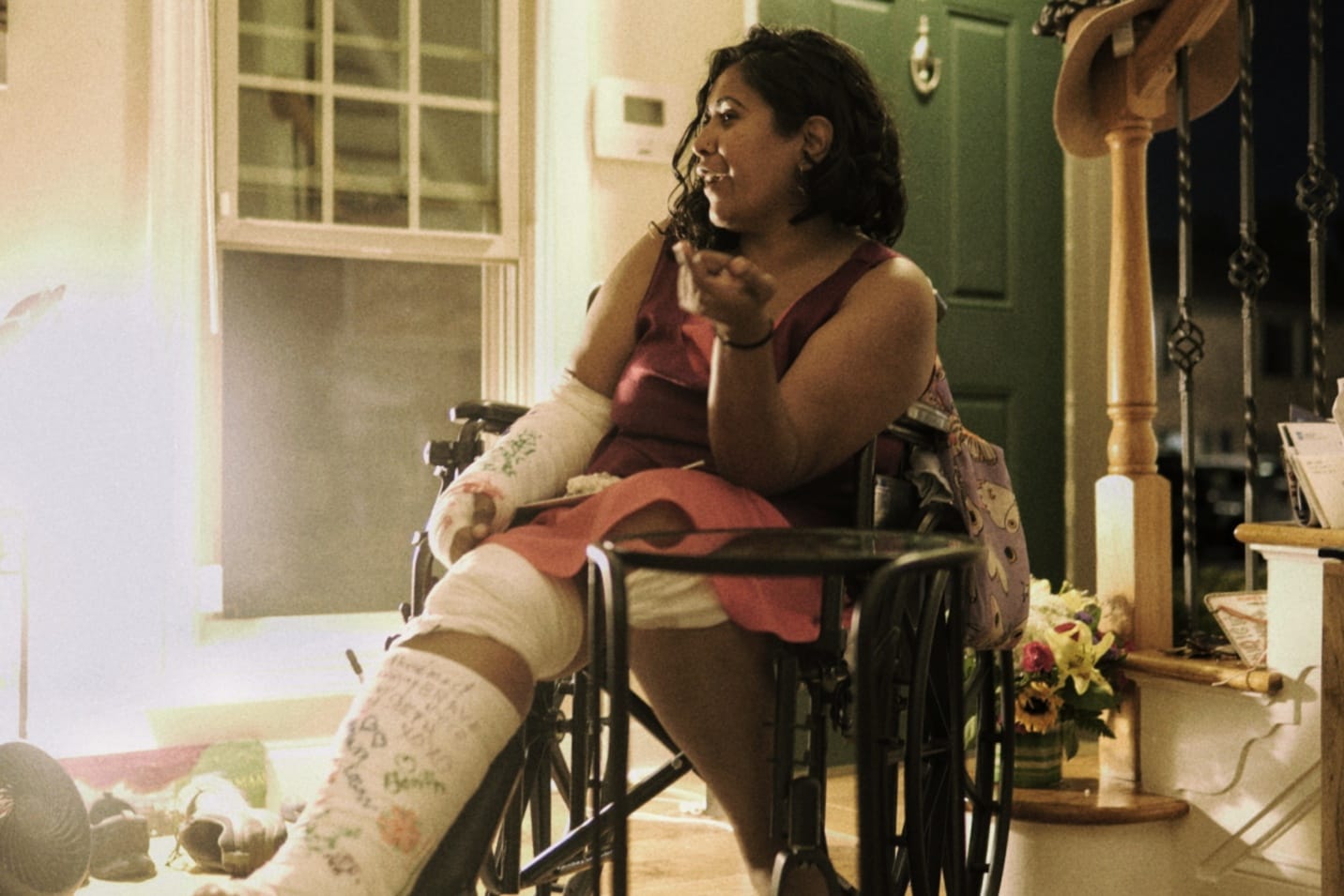
I have already faced the fact that I cannot ride bicycles (for another month or two…?). Recently I acknowledged that I cannot stroll around the city alone. Then, I confronted that I could not hike, camp, or kayak. I cannot socialize as I am used to. Now, I am in a new wave of grief about my physical scars. My face, teeth, wrist, and ankle will never look the same. In some ways, I am grieving the loss of my old body and the changes in my day-to-day life.
Lis, one of my wisest friends, pointed out that grief has no pattern. She says that it shows up whenever it wants to. Indeed, the Stages of Grief Model was coined by a psychologist in the late 1960s. It describes a non-linear process after an individual suffers a great loss or trauma. The stages include denial, shock, depression, and anger, ideally ending in acceptance. Lately, the hardest has been dealing with ANGER. For example, how do I deal with the fact that my face will never look the same? I am angry about that. Through a series of lotions and potions, I can try to lessen the scars on my skin. However, I know that some marks will remain. Who can I yell at about this? I have always seen anger as a negative emotion. It is a place I wouldn’t say I like to dwell. Yet, in my wheelchair, I know it sits in some pockets. The anger lurks around, just waiting to launch into another mental fit.
Over the last decade, I have gifted multiple copies of The Power of Now: A Guide to Spiritual Enlightenment. Through trauma, PTSD, and disappointments in the past, The Power of Now has been a spiritual salve. To deal with my current anger, I have turned again to the wisdom of Tolle. He writes that consciousness is the way out of pain. `The greater part of human pain is unnecessary. … The pain that you create now is always some form of nonacceptance, some form of unconscious resistance to what is.` As I ponder this, I can see the truth in this perspective. My denial (or disdain) about this new condition fuels the anger. The anger is a rejection of this `new me.` This angst could become a tough fight if I do not begin to accept my current condition. I may be able to dissolve the anger if I can come to accept that the `new me` is still ME.

It will take time to integrate the knowledge of grief patterns and the wisdom of acceptance. Until then, I will harness my energies to keep moving through the anger. My next strategy for social situations is to make humor a form of defense. For the next person that wants to comment on my condition, I will hurl a series of dark humor.
I can turn to jokes to shake up the conversation. As my friends check in on me, the best way to describe my recovery might be like sitting at the ocean shore. I watch the waves roll in. Then, out of nowhere, sometimes a wall of water, a tsunami, slaps me in the face. In response, I shake off the water, stand back up, and do a rain dance. Bring me all of it so that I can perhaps see the end. Or maybe I can explain to movie-watching friends that I went from being the star in a Disney movie to being the villain. I went from being the Beauty to becoming the Beast. In either case, I am still me. I am me in a new form.


